


12 min to read
|Jan 2024
Michelin-Quality Dining at a Fraction of the Cost
 1
1 Print or download


BON APPETIT

©KONDOROS EVA KATALIN/iSTOCK
What comes to mind when you think about a Michelin-starred restaurant?
A formal dining room… an army of well-dressed servers… cutting-edge, small-plate dishes… and prices that would make even a deep-pocketed diner’s eyes water.
If you’re eating at a restaurant with one, two, or even the elusive three Michelin stars, that’s likely the experience you’ll have.
As a self-proclaimed foodie whose son cooks in a Michelin-starred restaurant, I’ve spent many a happy evening indulging in some of the world’s “best” food… without making a dent in my travel budget.
For that, Michelin has a separate category: the Bib Gourmand.
This category is named after Bibendum, the “Michelin Man” company mascot, and recognizes high-quality food served at moderate prices. Currently, that moderate price sits at about $40 for a three-course meal: starter, main course, and dessert.
Just search the Michelin Guide’s Bib Gourmand category, which you can find here, and filter as needed. The map (found on the right side of the web page) will show you the nearest options. Clicking on search results will bring up the restaurant’s menu, hours, photo gallery, services (e.g., air conditioning, valet, and the type of tender accepted), as well as instructions for making a reservation.
I recently used this search feature to narrow down eateries in Nice, France. Nice, as you might imagine, is pleine with Michelin-recommended and starred restaurants.
For our Bib Gourmand experience, my partner and I settled on Fine Gueule, a traditional French restaurant in the heart of Nice. From Tuesday through Friday, Fine Gueule serves a set lunch menu that changes daily depending on availability. The menu includes an appetizer, a main course, and a glass of house wine, all for under €20 ($21).
We were seated on Fine Gueule’s terrace, where the waiter introduced us to that day’s menu. We began our meal with a carpaccio of beef with a homemade herbed mayonnaise, followed by a risotto à la gorgonzola with a mushroom emulsion, and washed down with a fruity pinot grigio.
With the money we saved on the meal, we decided to splurge on dessert: financier cake and fig ice cream, topped with pine nuts. The bill for two: €53 ($56). We agreed the experience was easily worth twice the price.
A tip for dining in France: Instead of still or sparkling water, ask for une carafe d’eau (a pitcher of tap water). The tap water in France is clean, and you’ll be charged for bottled water otherwise. —Jan Kirschner
CURIOSITIES
How a Tire Company Became Synonymous With Fine Dining

©BALKANSCAT/iSTOCK
In 1889, French brothers Andre and Eduoard Michelin founded the eponymous rubber tire company. At that time, there were less than 3,000 cars on France’s roads—far too few for the brothers to turn a profit.
To encourage tourism by car, the Michelin brothers developed a travel guide that included maps, gas station locations, and instructions for changing tires. By 1920, automobiles were an established mode of transport, and the brothers relaunched the Michelin Guide. This time, it included a list of hotels and restaurants.
Over the years, the Michelin Guide developed into the icon it is today. Mystery diners (whose identities are kept under wraps from family, friends, and even Michelin company executives) decide which restaurants are worthy of mention, using a rating system that recalls the Michelin Guide’s origins. One-star restaurants are “worth a stop,” two-star restaurants are “worth a detour,” and three-star restaurants are “worth a special journey.”
Outside of Michelin stars and the Bib Gourmand award, the guide also has a “green star” category for sustainable gastronomy and “The Michelin Key” for exceptional hotels. —Megan Ritchie
CURIOSITIES
Costa Rica’s Blue Zone: You Too Could Live to 100
What’s the secret to longevity and vibrant health? Ask the centenarians living in the world’s Blue Zones.
Back in 2004, researchers identified five regions as the Blue Zones: Nicoya, Costa Rica; Sardinia, Italy; Okinawa, Japan; Loma Linda, California; and Icaria, Greece. (In 2023, Singapore joined this list, called the Blue Zone 2.0.) These zones, with above-average longevity, hold insights into what produces lower rates of chronic illnesses and a longer life expectancy.
In Nicoya, many centenarians live by the plan de vida principle—having a purpose. You’ll find grandmothers handmaking corn tortillas in the mornings and 100-year-old cowboys riding their horses through the countryside. Families and neighbors foster tight-knit relationships, increasing happiness. Regularly being outdoors under sunny skies ensures ample vitamin D production, leading to good health and sturdy bones.
Plus, there’s the Costa Rican diet. Nicoya’s water, rich in calcium content, fortifies bones and may reduce heart disease rates. Meanwhile the Mesoamerican diet, mainly consisting of squash, corn, and beans, is nutrient-dense.
As an expat who’s lived in Nicoya for the past decade, I’ve consciously adopted some of the local practices, including cherishing time in nature (picture turquoise waterfalls, lush jungle paths, and remote, pristine beaches), nurturing community bonds, walking to town to buy groceries and fresh produce, and grounding myself by gardening.
Contrary to a fast-paced, first-world lifestyle, Blue Zone residents embrace a different mentality—not just existing, but truly living. Their secret lies in slowing down. And you can harness that power—the power of the Blue Zones—in your own expat life. —Bekah Bottone
FESTIVALS
Sumba Island, an Equestrian Paradise
If you’re standing on the island of Sumba in early March, you may witness one of the world’s marvels.
A herd of majestic Sandalwood horses tear past, hooves thundering. Eventually, they’ll hit a golden beach and plunge into the clear, turquoise waters of the Indian Ocean for their daily swim.
Sumba is an Indonesian island about an hour’s flight southeast of Bali. But unlike Bali, Sumba’s remained relatively untouched by tourism. The result is the preservation of Sumbanese culture, which highly values horses.
Here, horses aren’t a mode of transport or even beloved pets. To own a horse speaks of a family’s good standing—and when a man proposes, he offers a horse to his betrothed’s family.
Sumba’s herd of beach-roaming horses live freely within the Nihi Sumba Resort, cared for by a select team of Sumbanese natives. Nihi is made up of a couple dozen swanky villas, complete with private pools, but its true highlight is its “Equine Retreats.” These entail five days of swimming alongside the horses. You can check out the full itinerary here—or alternatively visit Sumba during the Pasola Festival.
For four weeks in February and March, the Pasola Festival ushers in the new rice season, with Sumbanese horseback riders throwing (blunt!) spears at one another in a practice believed to ensure a good harvest. You’ll also spot cultural events from a colorful parade to live music played on traditional instruments.
The next Pasola Festival is slated to kick off in early March 2024. —John Wallace
MONTENEGRO’S VISA FOR BOAT OWNERS

In my younger days, I spent a lot of time sailing big yachts around the Atlantic on behalf of their wealthy owners. Some of them had been as far as the Mediterranean… and its gorgeous offshoot, the Adriatic Sea.
One of the most attractive places on the Adriatic is the Balkan country of Montenegro. It has a long maritime history and is highly popular with recreational boaters. One reason for that is a unique visa program just for yachtsmen.
A foreign owner of a motor or sail yacht who enters into a mooring contract of 90 days or more with a Montenegrin marina becomes entitled to a residence permit that’s valid as long as the yacht is based in the country. You’re free to come and go as you please, as long as you’re not away from Montenegro for more than 90 days in one go.
The visa is designed with commercial charter operations in mind, so crews can remain in the country during sailing season. But it’s valid for private boat owners as well.
So if an extended sojourn in the Balkans is in your plans, be sure to point yourself and your boat toward Montenegro! —Ted Baumann

©MYROSLAVA/iSTOCK
UNIQUE STAY
Sleep With Lions in Australia
The most unique experience of my life: an overnight stay in Jamala Wildlife Lodge’s Giraffe Treehouse.
This offbeat hotel offers rooms inside Australia’s Canberra Zoo. The room where my wife and I stayed was as luxe as you might expect, given the lodge’s costly booking rates… and the chance to encounter wildlife from our balcony.
Outside the balcony (i.e., feeding platform) were two 18-foot-tall giraffes. We were able to feed them carrots by hand and watch them gorge on nearby bales of shrubbery.
As part of our tour, we also sat with three cheetah brothers (under the protective eyes of park employees), plus enjoyed feeding a family of energetic meerkats, begging for food from our hands.
In addition to the Giraffe Treehouse where we stayed, Jamala offers rooms with access to lions, cheetahs, hyenas, capuchin monkeys, and sharks. Guests are treated to introductions with the animals, a “safari” through the zoo, and an African-inspired dinner party.
Jamala’s price tag (a night will put you out a grand, unless you nab a deal) is well worth it. —Norm Bour

©KIMPO58/iSTOCK
EXPLORATION
Panama’s Award-Winning Green Adventures
Looking for a super-green, ultra-unique travel experience? Pack your bags. Panama’s Sustainable Tourism Master Plan has yielded 10 incredible new (and award-winning) sustainable visitor experiences.
The experiences fall under the country’s new SOSTUR program, which was just selected for the 2023 AFAR Travel Vanguard (a designation awarded to travel organizations that are “forces for good”). One of just seven honorees, SOSTUR is a group of government and nonprofit agencies that help connect indigenous communities and eco-travelers. Its pilot projects can now bring you to remote lands of incredible beauty that few people on the planet have ever laid eyes on.
Come to Panama to harvest cacao, pick and eat fresh bananas from the trees, and drink juice extracted from the sugarcane that grows in Mata Oscura, home to a model turtle conservation initiative. You can even visit what may be the last indigenous monarchy in the Americas.
Plan the adventure of a lifetime and contribute to the regenerative development of local communities. Visit www.sostur.org (use the menu at the bottom to switch from español to English), and don’t forget to send us a postcard. —Jessica Ramesch
SALUD!
Try Colombia’s National Drink: Firewater

©ANAMEJIA18/iSTOCK
“Are you sure you want to try the aguardiente? It’s super strong,” said the waitress at a rooftop bar in Medellín.
“As in, ‘I’m going to go blind if I drink it’ strong? Or as in ‘I’ll fall off my chair if I drink a bottle of it’ strong?” I asked. After assuring me it was the latter, my husband Mark and I ordered a bottle.
Aguardiente is Colombia’s much-prized local hooch. You can find it in all the bars and restaurants in the country. Most bars sell it by the fifth or in fancy craft cocktails, but we wanted to try it in its purest form: the shot.
The word aguardiente comes from a blend of agua (water) and ardiente (burning). Basically, the name translates to firewater. Once I figured that out, I braced myself, ready to embrace the burn, expecting a moonshine kind of blaze that would leave my esophagus screaming for a firehose.
While the waitstaff eyeballed me—making me even more nervous—I stood up (just in case). I took the shot… and was pleasantly surprised. No fire.
It tasted like black licorice or Sambuca—not as syrupy, but equally as warming. I quite enjoyed it.
It’s made from fermented sugar cane that’s distilled to smooth it out. The final touch of anise gives it that robust flavor. When I took a closer look at the bottle, I read the alcohol content. It’s a relatively low 29% compared to vodkas and whiskeys at 40%.
Each Colombian department, or state, distills its own variety, so wherever you travel, there will be a favorite local brand. In fact, aguardiente can be found throughout South America in some form or other.
Turns out, despite aguardiente’s infamous reputation, its bark is worse than its bite. Mark and I continued to drink our bottle—and remained firmly attached to our chairs. —Kirsten Raccuia

Also in This Issue

Where—and How—to Buy in the Dominican Republic and Costa Rica
▪ Graham says: I read your article about the Dominican Republic in last month’s issue. My wife and I are frequent...

Malta: Mediterranean Luxury for the Rest of Us
If you look for Malta on a globe, you may not find it. It’s only when you squint your eyes—and get close...
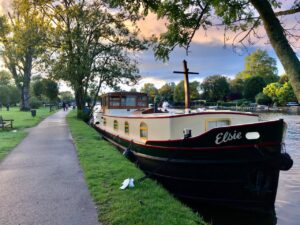
Our English Oasis: Barge Living on the Thames
Name: Bill and Lucinda VoorheesFrom: Colorado Springs, COLiving in: Isle of Wight, England Our home has a key advantage most don’t: an engine...
Where—and How—to Buy in the Dominican Republic and Costa Rica
▪ Graham says: I read your article about the Dominican Republic in last month’s issue. My wife and I are frequent...
Malta: Mediterranean Luxury for the Rest of Us
If you look for Malta on a globe, you may not find it. It’s only when you squint your eyes—and get close...
Our English Oasis: Barge Living on the Thames
Name: Bill and Lucinda VoorheesFrom: Colorado Springs, COLiving in: Isle of Wight, England Our home has a key advantage most don’t: an engine...