


10 min to read
|Jan 2023
A Warm Welcome and a Happier Life in Europe
 1
1 Print or download


©FREEARTIST/iSTOCK
“I Live in My Happy Place and Can Easily Pay My Medical Care”
Name: Karen Lefebre-Christou
From: Austin, Texas
Living in: Syros, Greece
Have you ever gone on vacation and thought, “I could live here” only to return back home to the grind and get sucked back into your routine? That was me, when I spent summers on the island of Syros, Greece. I regularly window-shopped houses posted at the real estate office on the island and perused homes to purchase online.
I had lived and worked in Greece for almost five years after graduating college, before the idea of a “real” career lured me back to the U.S. I spent 26 years wrapped up building my family, pursuing a career and accumulating financial security, but always felt drawn back to my “happy place.” The summer of 2020 brought about some major life changes which gave me the impetus to try living in Syros once again. My son and I packed up a few suitcases, his bicycle, and our cat, and escaped to paradise.
Sitting on the balcony during self-quarantine upon arrival, we sat watching the turquoise and deep blue Aegean Sea for hours, mesmerized. We didn’t even mind that we couldn’t leave the house. Our belongings were few, but we didn’t miss what we had left behind. We felt refreshed and ready for a new beginning.
My son started his freshman year in college remotely—his Abu Dhabi campus closer than our former address in Austin. I kept my U.S. job as a public school teaching assistant, since I was able to do it remotely during the lockdown. The schedule worked perfectly for me and allowed plenty of time for chores, food shopping and preparation, my daily swim, and socializing on the weekends.
When teachers were sent back to campus, though, I was served an ultimatum: Return to campus or lose your job. Honestly, this was a no-brainer for me. As a newly minted single mom with a complex medical history, I simply couldn’t afford to live in Austin. In Greece, though, I was able to live in my happy place and pay for my medical care easily out of pocket. I chose me. I chose my dream.
Two years later, I’m thriving. Embracing the slower pace of life here feels like putting on a comfortable pair of jeans. It simply fits and feels like me. I look back on how I used to run through my days in the U.S. and wonder what was so important.
My life is far from solitary. The community in Syros has embraced me—Greeks and expats alike. I participate in Greek dance lessons, volunteer teaching art classes to local kids, attend a weekly Sunday swim and potluck with a group of expats, and can be found at various cultural and social events around the island if the mood strikes. I have a full, enjoyable life here.
If you dream of living in your “happy place,” at a slower pace, where your money can go further and a medical event won’t bankrupt you, I would heartily recommend taking that first step toward freedom. When people sigh and tell me I’m so lucky to live here, I agree with them. It’s really just a decision. And just about anyone can choose to do the same.—Karen Lefebre-Christou
“I Now Help Other People Realize Their Overseas Dreams”
Name: Patricia C. Brooks
From: Richmond, Virginia
Living in: Céret, France
In the south of France, Patricia C. Brooks’s days are bookended by the morning serenades of roosters and the evening calls of owls. Four-and-a-half years ago Patricia left her home in Richmond, Virginia to start a new life in Céret, France.
“Céret is lined with magnificent plane trees, and it’s got personality,” Patricia says. “If you go one village to the east or west of Céret, there isn’t a lot to do. Here, we’ve got several restaurants and cafés, a couple of museums, and a vibrant art scene.”
In the early 20th century, artists such as Picasso and Matisse flocked to Céret to create works of art, some of which are now on display in the town’s celebrated Museum of Modern Art. The town is located in the foothills of the Pyrenees, about 10 miles from the Spanish border. Canigou, a dramatic mountain peak considered sacred to the area’s Catalan residents, overlooks the town.
Patricia lives a few minutes from Céret’s centre-ville in a small apartment building with nine units. Her apartment has views of Mount Canigou and the historic town center. “The rooftops are red clay, and I can hear the church bell chiming in the distance, which warms my heart each time I hear it,” she adds.
“
Before moving to France, Patricia worked as a project manager in the health insurance industry. In 2016, she became a Certified Professional Coach. Today, she helps people realize their dreams of moving overseas through her business, The Courage Catalyst.
“I help single women who want to live abroad, but who doubt it’s possible,” she says. “I also offer one-on-one coaching to help them work through the challenges of moving abroad confidently and sustainably. I’ve had my practice here in France for just over a year now.”
To start a business in France, Patricia transitioned from a long-stay visitor’s visa to a profession libérale visa, a process that she says was manageable. “While it required creating a detailed business plan with three years of revenue projections, the items required were pretty straightforward,” she explains.
Patricia’s new career allows her to work from home and set her schedule. “It is very diverse, which is one thing I like about being an entrepreneur,” Patricia says. Outside work, Patricia makes a habit of walking or hiking daily and meditating. She recently began flute lessons at the local music school, as well as Qi Gong.
Through persistence and hard work, Patricia has also become fluent in French, something she previously thought was impossible.
“In high school and college I never believed I could be fluent so I did just enough to pass the classes. But having the goal of living and integrating in France, I worked to change that belief which motivated me to be consistent with lessons,” she says, adding that she used the Pimsleur Method and language lessons. Her tips?
“Practice every day, even when you don’t see progress. Progress is happening. Don’t be afraid to make mistakes or sound bad—it’s the only way.”
Having created a business and acquired the language, Patricia intends to stay in France long-term. “Once I’ve saved up enough, I’d like to buy a house here,” she says. “That said, who knows where this incredible journey called life will lead me?”—Tricia A. Mitchell
“A Beach Town That’s Welcoming to Alternative Lifestyles”
Name: Robert Blume
From: Hays, Kansas
Living in: Sitges, Spain
“Sitges is equally distant from Italy and Algeria,” says Robert Blume. “These are the things I love about living here—fascinating facts.”
Robert is loaded with them. As a resident of Sitges for over 25 years (and a consistent visitor for nearly 40), he knows the town like a guide.
“It’s two towns in one. There’s the quaint seaside fishing town of 5,000 people built around a 17th-century cathedral. That’s how it is during the week and through the winter months. But from Thursday to Monday, especially during the summers, it turns into a crowded, wild party town with a population of 50,000. Clubs are open all night and half the beaches go nude. It’s like having two different towns. I live in both of them.”
“When I retired and came here permanently I made a lot of changes. One of them was that I would not buy a car. I was overweight and out of shape, but years of walking keeps me trim.”
Robert bought his house in 1994 when Valle De Pin, a semi-private estate built around a sports complex, was new. He got it for about a tenth of its current value of around $750,000. The four-bedroom, two-bathroom villa has a good-sized garden, a pool, and a terrace that overlooks the town, beach, and sea. The tower of the town’s Baroque cathedral is central and he can check the time by the chimes that ring at the top of each hour.
Spain’s rail system is affordable, comfortable, and convenient. Trains from Sitges leave about every 10 minutes into Barcelona for $4, where links will take you anywhere in Spain and most of Europe beyond. “I’ve traveled as far as Norway using only the train system. And I can be in Paris in eight hours, any day of the week,” Robert says.
Robert grew up in Hays, Kansas, a mid-sized city where he lived until he retired. “I was a momma’s boy, graduated high school, went to community college, got a job as an accountant for the city, lived at home. That was just about all there was until in the mid-1980s, when I came to Barcelona with my church group.
“My friend Pat and I both sang in the church choir and we were the only two men on the trip. After a few days of following these old gals around I got this brochure for Sitges, only 40 minutes away by train then (it’s 20 minutes today). Our excuse was we were going to see the cathedral, but what we found was this beautiful beach town that was also incredibly welcoming to alternative lifestyles.”
There was no gay scene where Robert lived in Kansas, so the community he found in Sitges was the first place he felt accepted. He started visiting, first twice and then up to four times a year. When it became obvious that he was committed to the location, he bought his first apartment in the center of the town for $16,000. He’s rented that out for years, while adding his other properties. They now provide him with a nice passive income.
On a hot day, the town beaches of Sitges are crowded and the cafés and restaurants in the center of town are full of day-trippers. But it’s easy to get away from the crowds. Nature trails lead away from the town to wild beaches tucked into coves where the Mediterranean laps on white sand and people picnic and snooze in the sun.
In a café, Robert points out the perfect ingredients for a picnic. “Four or five tapas—small sandwiches filled with Spain’s famous ham—at $2 to $3 per piece. Some cheese, olives, sundried tomatoes…$1 per serving. Two bottles of wine, or the equivalent amount of beer, and two bottles of sparkling water all come out to around $30. “You pay double in Barcelona, and you can’t get any of this in Hays, Kansas!”
Sitges has similar weather to, say, San Diego, so neither heat nor air conditioning is much of a concern. That makes utilities affordable. Robert pays a few hundred dollars a month, but points out that his home’s high electric bill is due to his pool. “I don’t think I would be nearly as healthy and able at this age if I had stayed in Hays, and I know I wouldn’t have had this much fun.”—John McMahon

Also in This Issue
Calendar: Retire Early With This Portable Side Income
“Online Income Engine” Masterclass (Online) • March 11, 2023 A future-proof portable income. That’s what this is about. Ian Bond,...
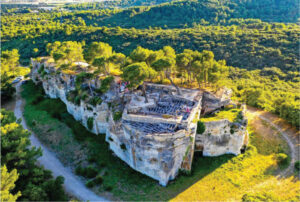
Curiosities, Quirky Tidbits, Useful Notes
A remarkable French abbey… The waterfalls of Costa Rica… The origins of tapas… Portugal’s digital nomad visa… A magical art...

A Little Piece of Island Paradise
The clear, turquoise water laps gently against bright, powdery white sand. To my right the beach cones to a point...
Calendar: Retire Early With This Portable Side Income
“Online Income Engine” Masterclass (Online) • March 11, 2023 A future-proof portable income. That’s what this is about. Ian Bond,...
Curiosities, Quirky Tidbits, Useful Notes
A remarkable French abbey… The waterfalls of Costa Rica… The origins of tapas… Portugal’s digital nomad visa… A magical art...
A Little Piece of Island Paradise
The clear, turquoise water laps gently against bright, powdery white sand. To my right the beach cones to a point...